


What happens when a coding error crawls its way into a patient's invoice?
The result is a chain reaction, starting with claim denials, providers struggling to recode and resubmit claims, and patients receiving the wrong copay. This not only affects the revenue cycle but also takes a toll on patient satisfaction.
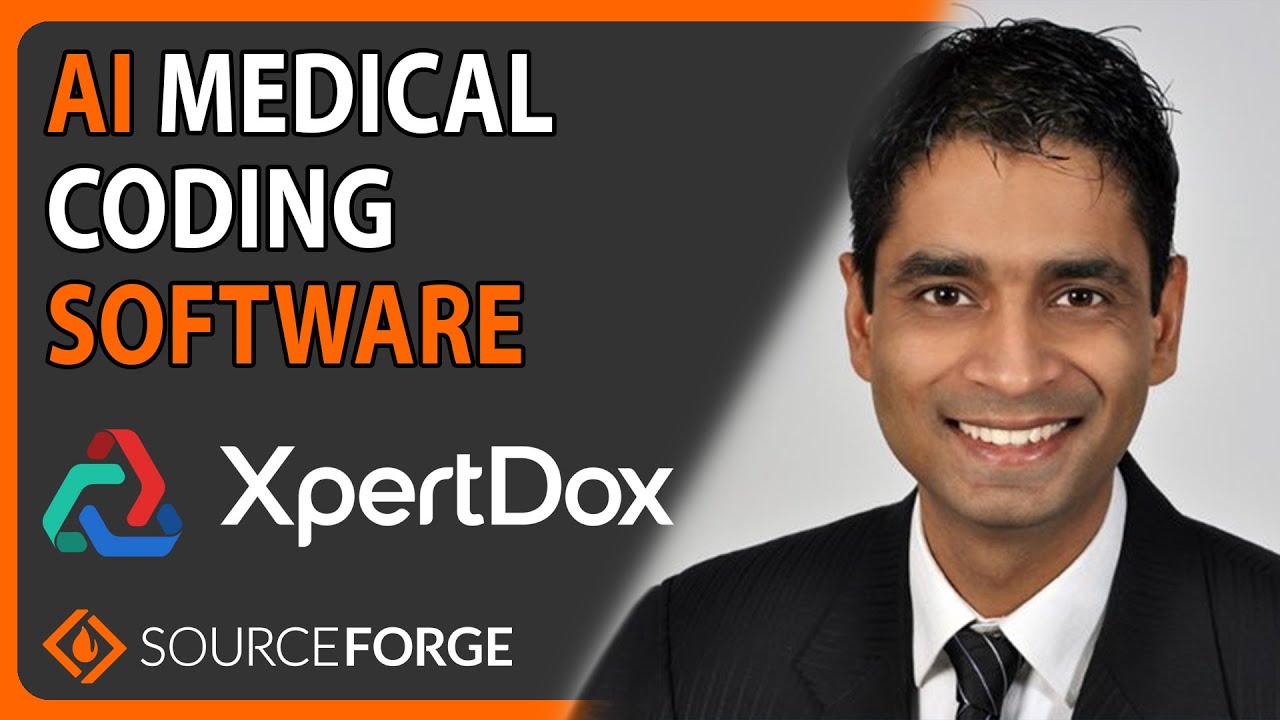
In this episode, Sameer Ather, a practicing physician and CEO and Co-Founder of XpertDox, joins SourceForge host, Beau Hamilton, to discuss how AI medical coding solutions are finally breaking this cycle for good.

Takeaways from the Podcast
- •Simple AI medical coding tools have gone beyond structuring workflows; they are improving revenue cycle management.
- •AI medical coding can deliver close to zero claim denials, not just in theory but in practice.
- •The role of XpertCoding in transforming healthcare operations and delivering tangible results.
Also Listen On:


Rare Diseases to AI Medical Coding: The Evolution of XpertDox
For decades, healthcare processes relied on complex handwritten notes and acronyms. Today, when most of the healthcare industry has shifted to Electronic Health Records, the handwriting has somehow carried through. The result is more than documentation gaps; it affects organizational workflows and the financial health of healthcare organizations.
As a practicing physician, Sameer saw this through a different lens. With a unique background in artificial intelligence and data analysis, he was always interested in leveraging advanced technical tools to extract meaningful value from complex healthcare data.
This passion was also shaped by visionary advice from a mentor during Sameer's PhD at Baylor College of Medicine. In 2007, that mentor urged him to pivot toward AI, predicting that it would one day guide clinical decision-making, a concept that intrigued him deeply. Driven by this advice and his own desire to unlock the intricacies of medical data, Sameer started XpertDox, which initially launched to solve data access and matching challenges in the rare disease space before evolving into the autonomous AI medical coding solution it is today.
That transition emerged from the intersection of Sameer's dual worlds, where realization turned into necessity.
The Turning Point - Medical Coding AI
It was 2021. Hospitals were drowned in COVID cases and testing requests. There was a greater turmoil behind this. Across the country, clinics were months behind their claim submissions. For hospitals, a claim not submitted is a claim not paid. During such a sensitive time, this was a compromise clinics couldn't afford.
This crisis brought us our first client. We built our first Minimum Viable Product (MVP) in 2022 for them, and the results were hard to ignore. The pain points Dr. Ather and his team uncovered became the operational blueprint and vision for XpertDox.
This is what led us to develop our flagship autonomous medical coding solution, XpertCoding.
Improving Healthcare Revenue Cycle Management with AI
The results that the urgent care chain saw spread through word-of-mouth. We slowly started tailoring our solution to fit the needs of different healthcare organizations. This process made the gaps more visible than ever, reinstating our vision to improve the healthcare revenue cycle.
Healthcare is an industry constantly regulated with tight scrutiny. The more we solved, the more we realized claim denials were only the surface of a bigger problem. Revenue cycle management is costly and complex. Healthcare organizations are already understaffed.
Additionally, the organizations and healthcare providers also have to deal with 30-40% of the claims getting denied in the first pass. Having a dedicated team for this would simply not be sustainable.
Without having one, clinics can jeopardize their care delivery. XpertCoding was designed to address this gap, allowing organizations to focus on what matters most: delivering quality patient care.
Behind the Scenes
It's been 15 years, even after the Affordable Care Act, and the healthcare system remains fragmented. When a provider or a clinician writes a clinical note, that note becomes a source of data that tells about patient history, complexity, current treatment, and even future patterns to some extent.
Fragmentation is part of the complexity. The real challenge is how patient data is processed across different models.
- •Fee-for-Service – Healthcare providers get paid for each service they provide. The idea is to capture individual, high-volume line items and procedures seamlessly.
- •Value-based Care – Providers are paid based on the care provided to the patient relative to their risk profile and complexity.
- •Quality Metrics – Quality metric benchmarks are plugged into both of these models. For example, diabetic patients should have a hemoglobin A1c below seven, and patients with hypertension should have blood pressure below 140 systolic or 90 diastolic.
In real-world scenarios, these models sometimes intersect. Hence, at XpertDox, we do not have a rigid mandate of how we deploy our solution. We let the client decide which integration is the easiest and most efficient for them.
AI in Healthcare: Limits & Trade-Offs
Back in 2022, there was skepticism around AI's adoption. The narrative has completely changed now. Market belief and comfort levels with advanced automation have grown exponentially, fundamentally changing how healthcare executives view AI medical coding. This pivot is definitely a top-down approach wherein corporates and CEOs are under pressure to implement AI solutions that can improve efficiency, reduce administrative burden, and protect revenue.
Still, healthcare is one of the last industries to be touched by complete innovation and automation. So many processes haven't been touched yet because healthcare runs on safety. PHI, HIPAA compliance, patient data safety, etc., make it hard for tech companies to move fast.
With Sameer drawing the dot-com parallel, it is clear that overpromising by organizations is inevitable, but transformation is real. Achieving this level of enterprise-grade security and precision requires moving past basic, single-algorithm solutions.
'To build a platform like this, it requires immense teamwork. We have an automation team, a data analytics team, an informatics team, and an audit team. We do not rely on any single AI tool; we deploy multiple technologies, which is why we call it "hybrid AI." I am a big fan of gradient boosting, which we use extensively. We use transformer neural networks a lot. We use rules-based systems as a final checkpoint and have a human-in-the-loop audit system. We take accuracy in AI medical coding very seriously.'
- Dr. Sameer Ather, Co-founder & CEO, XpertDox

This hybrid approach ensures that accuracy stays intact even at scale. It is the right balance of innovation and compliance without compromising efficiency.
We thank SourceForge and host Beau Hamilton for such an energetic conversation and giving us the space to discuss our story and vision for XpertDox.
About XpertDox
XpertDox is an AI medical coding solutions provider. XpertCoding, our flagship platform, accelerates revenue cycle management, reduces denials, and recovers revenue that clinics would otherwise lose. The goal is simple: less time on administration, more time with patients.
About SourceForge
SourceForge is a complete software review and comparison platform. SourceForge provides a business software comparison platform, where B2B software buyers can compare business software, SaaS, and services across thousands of B2B software and services categories.
About the Host
Beau Hamilton is a Senior Editor and host of the SourceForge Podcast, where he interviews founders and executives behind impactful B2B software and IT companies. A Portland State University graduate and tech video producer of over a decade, he has worked with companies like Google, Samsung, and OnePlus and curated content for Slashdot since 2016.